
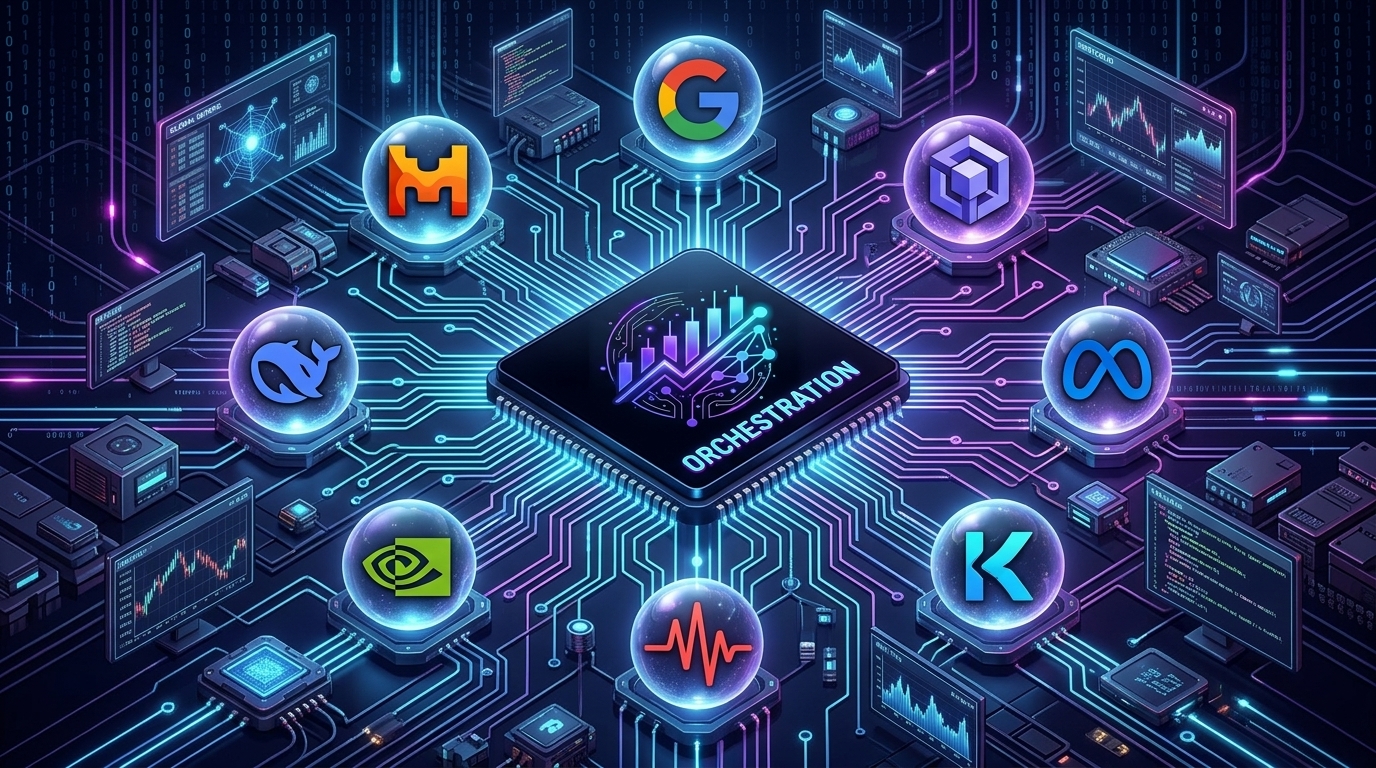
A trade is not one decision.
It’s scanning the market, analyzing structure, forecasting price, sizing the position, checking risk, confirming the setup — and every other part of the trading workflow that never makes it into a screenshot.
Hand all of it to a single model and most of those steps run on a model that isn’t the best at them. Each of those steps has a best LLM to perform it. So we stopped asking “which model should we use” and started asking “which model wins at this specific job.”
Built as sub-agents, not one big prompt
FNXT is a true sub-agent system. Every step of the workflow is its own agent, with its own inputs, its own outputs, and its own definition of success — wrapped in a harness strong enough to measure it.
That harness is the whole point. Because each sub-agent is isolated and measurable, we can run the identical task across many different models and compare them head to head: accuracy, instruction compliance, hallucination rate, latency, cost. Then we assign the winner and move on to the next task.
The research never stops
Our infrastructure processes over 200,000,000 tokens per day. That is not a vanity number — it is the sample size behind every routing decision we make. Production logs, not paper benchmarks.
Currently in production rotation:
- Google — Gemini 3.1 Pro, Gemini 3.5 Flash, Gemma 4, and TimesFM for time-series forecasting
- Moonshot AI — Kimi K2.6
- Alibaba — Qwen 3.5 122B
- NVIDIA — Nemotron 3 Super and Nemotron Nano
- DeepSeek — DeepSeek V4
- Mistral, Meta Llama, Z.ai GLM, MiniMax
And when a new frontier model ships, it goes straight into the harness — measured against the incumbent on real trading tasks, and promoted the moment it wins. The roster is never frozen, because the field never stops moving.
Smart routing is the core
FNXT is designed as a multi-agent system, and the routing layer is the heart of the orchestration. It decides which model handles which sub-task, in which order, under which constraints — then runs them together as one coherent pipeline instead of a dozen disconnected calls.
Different vendors. Different architectures. One trade.
And then they vote
Specialization alone isn’t enough. A confident model is not a correct model.
So before a strategy, a forecast, or a trading signal goes live, it’s reviewed by several models from different providers. Each forms its own independent read of the market first, then votes on the proposal.
Cross-vendor agreement is real signal — separate training data, separate architectures, separate blind spots. No echo chamber. And when they don’t agree, the decision doesn’t ship as it stands: the agent receives the objections and revises.
This is where the design pays off mathematically. A single model’s judgment carries that single model’s error rate. Independently trained reviewers fail in different places — so their agreement compounds confidence instead of repeating it. Every specialist raises the probability that its own step is right; every consensus check raises the probability that the decision as a whole is right.
What reaches your chart is the outcome the entire stack agrees is the most probable one.
Every assignment is visible, and yours to override per symbol. The routing is ours. The final call is always yours.